What Our Fact-Check Caught in Six AI-Drafted Blog Posts
We logged every correction made to six AI-drafted posts on this blog before they went live. 19 claims had to be fixed, and none of them was an invented source. Most said more than their source did. Here is the tally, plus the two errors that got through anyway.
Blogtastic Team · November 5, 2026
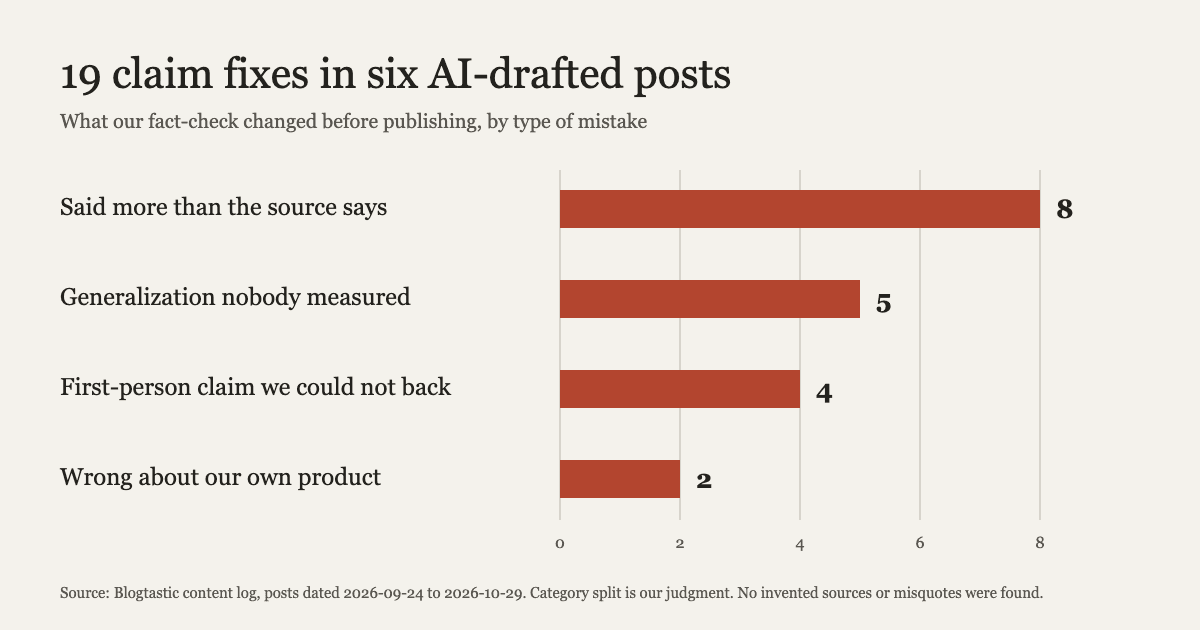
Across six AI-drafted posts on this blog, our pre-publish fact-check changed 19 claims. None of them was an invented source or a misquoted passage. The most common problem, 8 of the 19, was a sentence that said more than the source it cited. The next most common was a confident generalization that nobody had measured. Two errors got past the check and are still live on this blog as of November 5, 2026. Both are described below.
The numbers come from our own content log, which records what was cut or corrected in each draft before a person approved it. It is a small sample from one blog, so read it as a field report, not a benchmark.
Key takeaways
- 19 claim fixes in 6 posts, between 1 and 6 per post.
- 8 fixes were overstatements of a real source. Checking that a source exists is not enough. Check that it says what your sentence says.
- 4 fixes were first-person claims ("our experience", "our rule") with nothing behind them. Left in, they would have faked an experience signal.
- 2 fixes were wrong statements about our own product, and only reading the code caught them.
- One claim was correct on the day we checked it and went out of date when Google updated its page. A fact-check has a date on it.
How many fixes did each AI draft need?
Between 1 and 6 claim fixes per post, 19 in total across the six posts we logged in full. The table also counts two kinds of edits that are not about facts: lists of three rewritten because our style rules treat them as an AI tell, and images re-rendered because a label overlapped something.
| Post (date) | Claim fixes | Lists of three rewritten | Image fixes |
|---|---|---|---|
| Programmatic SEO vs spam (Sep 24) | 2 | 1 | 0 |
| Human review workflow (Oct 1) | 5 | 1 | 0 |
| Cost of a blog post (Oct 8) | 1 | 4 | 1 |
| AI content detectors (Oct 16) | 3 | 6 | 2 |
| AI content and E-E-A-T (Oct 23) | 6 | 7 | 1 |
| Deleting posts with no traffic (Oct 29) | 2 | 4 | 0 |
| Total | 19 | 23 | 4 |
Our first post, from September 22, is left out because its log entry has no list of corrections, and we did not reconstruct one after the fact.
How we counted: one fix is one item in the corrections our log notes for that post. Where a note bundles two changes, we counted them separately. Edits made while drafting and never written down are not counted, so treat every number as a minimum. The split into the categories below is our own judgment.
What kinds of mistakes did the AI drafts make?
Overstating a real source was the most common, with 8 of the 19 fixes. Here is every category with an example taken from our log.
| What went wrong | Fixes | Example from our log |
|---|---|---|
| Said more than the source says | 8 | A draft said trust is "the one Google ranks highest". Google says "trust is most important" and that E-E-A-T "isn't a specific ranking factor". |
| Generalization nobody measured | 5 | "A typical product-focused post will have fewer" factual claims. We had no data on that. |
| First-person claim we could not back | 4 | "From our own experience building content pipelines", in a post that showed no such experience. |
| Wrong about our own product | 2 | Pressing Publish again "updates the existing post". Our dashboard dialog says so, but the integration code only ever creates a new post. |
Overstatements are the hardest to catch, because the link checks out. The source is real and it says something close. One draft described a study as comparing simplified writing with "ornate" writing, when it compared simplified vocabulary with the original essays. Another presented a Google passage as general advice when Google wrote it for sites that had dropped after a core update. A reviewer who clicks the link and sees the right page will pass both.
The first-person claims matter for a different reason. Google's helpful content guidance asks whether content is "written or reviewed by an expert or enthusiast who demonstrably knows the topic well." A sentence like "in our experience" is exactly the signal a reader uses to answer that, which is why an invented one does more damage than a wrong number. We wrote more about this in our E-E-A-T article.
Did the AI invent sources or quotes?
Not in the posts we logged. None of the 19 fixes involved a source that did not exist or a quote that was not on the page. Since October 23 we have also checked every quoted phrase word for word, by script, against the text of the page it came from, and no quote has failed that check.
That is a result from our process, not a property of the model. Our workflow fetches the sources before a draft is written, so the source text is available while drafting. That is one of the techniques Anthropic's guide to reducing hallucinations recommends. The same guide says these techniques "don't eliminate them entirely." Six posts is far too few to say it cannot happen.
Two sources could not be read at all. One was an OpenAI terms page that blocked our fetcher, the other an industry survey behind a bot challenge. In both cases the draft dropped the source instead of citing its figures from secondhand reports, because our fact-check rules require the original.
What got past the fact-check?
Two claims on this blog are wrong or out of date right now. Neither was caught before publishing.
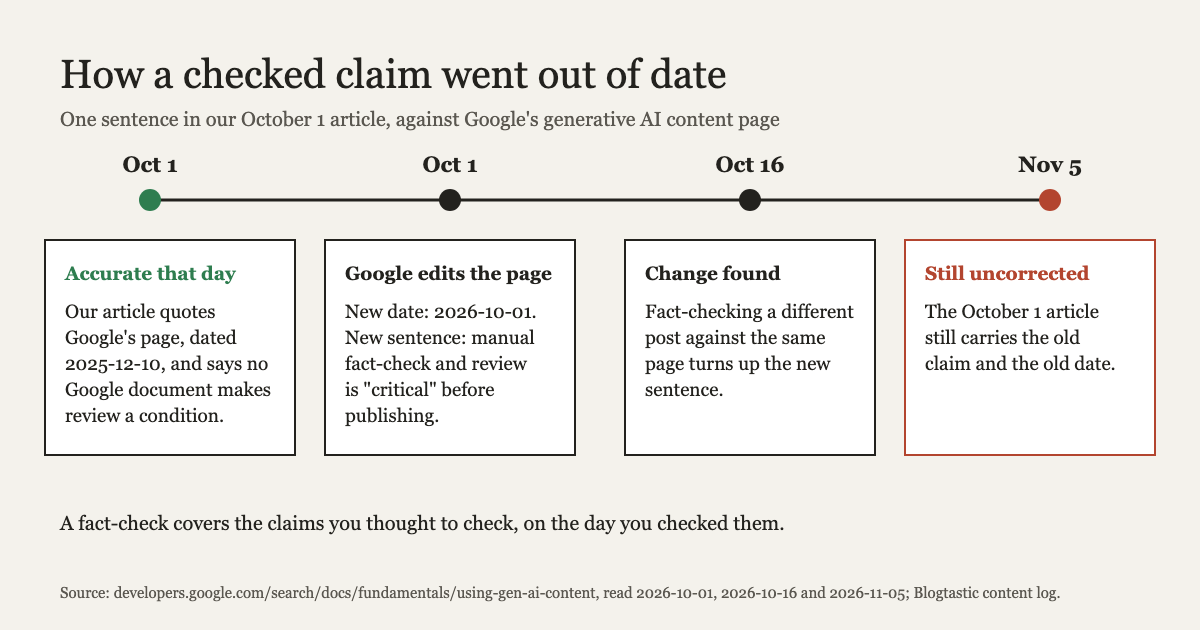
A Google page changed after we quoted it. Our October 1 article on human review says "Nothing in Google's documentation makes human review a condition" and quotes Google's generative AI page as last updated 2025-12-10. That was accurate when we checked. Google's guidance on generative AI content now carries an update date of 2026-10-01, the day we checked it, and says: "It is critical to manually factcheck and review all AI-generated content for accuracy and trustworthiness before publishing." It does not say what happens to sites that skip review, so "Google now requires review or you get penalized" would overstate it too. We found the change on October 16, while checking a different post against the same page. As of today, the October 1 article has not been corrected.
A sentence about our product was never checked against the product. Our first article, from September 22, says Blogtastic was built "with review checkpoints instead of a firehose." Nine days later, while reading our code for the review article, we found that when a publishing integration is connected, each generated article goes live with no approval step. That sentence oversells the product as it works today. It was missed because the first fact-check covered Google's policies and our plan limits, and nobody treated a sentence about our own product as a claim.
Both misses have the same cause. A fact-check covers the claims you thought to check, on the day you checked them.
What did we change that was not a fact?
We rewrote 23 lists of three and re-rendered 4 images. Our style rules treat three-item emphasis lists as a recognizable AI pattern, and the drafts produced them steadily, between 1 and 7 per post. They are not errors, but a reader who has seen a lot of AI text spots them, and that costs trust before anyone checks a fact.
The image fixes were layout problems, such as a rotated axis caption sitting on top of other labels and a quote touching a box border. All four were caught by rendering each image and looking at it. None would have been caught by reading the markdown.
What should you check in your own AI drafts?
Check what each sentence claims, not only whether its link works. These are the five checks that map to what our log caught and missed.
- Read the source sentence next to the draft sentence. Look for wording that is stronger or broader than the source's, such as a ranking effect the source never mentions.
- Mark every unmeasured generalization. Words like "most", "many", "typical" and "usually" need a number behind them, or they go.
- Ask for the evidence behind every "we" and "our". If nobody can point to the thing the sentence describes, cut it.
- Check product claims against the product. Interface text and marketing pages are not proof. Our wrong republish claim came from a dialog in our own dashboard.
- Date every policy quote and recheck it on a schedule. The page we quoted on October 1 changed the same day.
Google's own self-assessment list includes the question "Does the content have any easily-verified factual errors?" The checks above are how you answer it with something other than a guess. Our human review article has a fuller reviewer checklist and the math for how much review time a monthly volume needs, with the caveat about Google's page described above.
Were these posts written by Blogtastic?
No. These posts were drafted by a general-purpose AI model working from a written brief and our style rules, with each post's sources fetched before drafting. They were not produced by the article generator inside Blogtastic, which writes customer posts from topic suggestions and site instructions. So these numbers describe AI drafting under a strict process. They are not the error rate of our product, and we have not measured our generator's output this way yet.
The checks apply to our generator's output in the same way. In Blogtastic, a generated article stays a draft until you press Publish if no integration is connected, so you can run them in the editor first. With an integration connected, the article goes live without that step, and the checks have to happen afterwards, in your CMS. Our pricing page lists how many articles each plan generates per month, and every one of them needs this review.
This article was drafted with AI and checked on 2026-11-05: its figures against our own content log, its quotes against the pages linked above. It stayed unpublished until a person reviewed and approved it. If we publish another tally, this article's own corrections will be in it.