How to Add Human Review to an AI Content Workflow
Human review only counts if it happens before publishing and the reviewer can block the article. Here is what to check, how many hours it costs at each publishing volume, and where our own product publishes without that gate.
Blogtastic Team · October 1, 2026
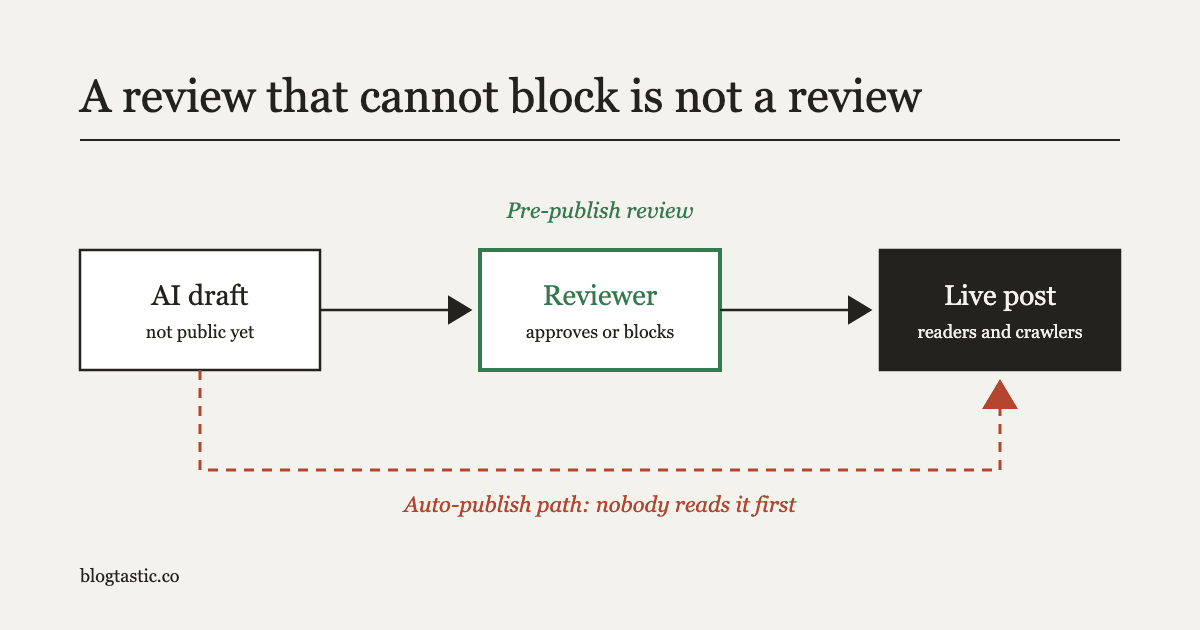
Adding human review to an AI content workflow means putting a person between the draft and the publish button, giving that person the power to block the article, and giving them a written list of what to check. Reading the post after it is live is a different activity. It is correction, and it happens after readers and crawlers have already seen the mistake.
We sell blog automation, so start with our own pipeline. As of 2026-10-01, when a Blogtastic site has a WordPress, Shopify, or Webflow integration connected, each generated article is sent to that platform as a live post in the same job that writes it. Nobody approves it first. When no integration is connected, the article waits as a draft in the dashboard until someone presses Publish. Our product has a review gate in one configuration and none in the other, and you should know which one you are running.
Key takeaways
- A review gate is a state the article sits in until a person moves it. If the tool publishes on its own, you have a correction process, not a gate.
- Google does not require human review of AI content. It asks for accuracy, and its self-assessment questions include one about factual errors and one about whether content was "written or reviewed" by someone who knows the topic.
- Review time decides how much you can publish. At an assumed 20 minutes per article, 30 articles a month costs 10 hours of review and 90 articles costs 30.
- With a connected integration, Blogtastic currently has no approval step before a post goes live. The last section covers what you can do about that today.
Does Google require a human to review AI content?
No. Nothing in Google's documentation makes human review a condition for AI-generated content. What its guidance on generative AI content (last updated 2025-12-10) asks for is an outcome: "focus on accuracy, quality, and relevance, especially when automatically generating the content." How you get there is left to you.
Review is the practical way to get there, because two of the questions in Google's guide to creating helpful content cannot be answered by the system that wrote the draft:
- "Is this content written or reviewed by an expert or enthusiast who demonstrably knows the topic well?"
- "Does the content have any easily-verified factual errors?"
Note the wording "written or reviewed". Google presents these as self-assessment questions, not as a ranking checklist, so we will not claim that adding a reviewer moves rankings. We have no data showing that. The claim we can stand behind is narrower: without review you cannot honestly answer either question.
The second reason has nothing to do with Google. Language models sometimes produce text that is factually wrong, and the companies that build them say so. Anthropic's own documentation on reducing hallucinations lists several mitigation techniques and then warns that "they don't eliminate them entirely." A wrong price or an invented product feature on your blog costs you with customers long before any search engine reacts.
What should a reviewer actually check?
A reviewer should check the things the model had no way of knowing and the things a reader can verify in a minute. Tone and style come last. Here is the list we work from, with the question each line answers.
| Check | What the reviewer does | Question it answers |
|---|---|---|
| Facts | Opens a source for every number, date, price, and named person or product. No source, no claim. | "Does the content have any easily-verified factual errors?" |
| Your own business | Confirms every statement about your prices, features, stock, and policies. The model only knows what it was given. | Same question. These are the errors your customers catch first. |
| Original substance | Names one thing in the article that the current top results do not contain. If there is none, the article goes back. | "Does the content provide original information, reporting, research, or analysis?" |
| Title and meta description | Checks that they match the body and promise nothing the article does not deliver. Google's AI guidance covers metadata explicitly. | "Does the main heading or page title avoid exaggerating or being shocking in nature?" |
| Links and images | Clicks every link and confirms the page supports the sentence it is attached to. Checks that the image loads and fits the article. | Same factual-error question, applied to citations. |
| Overlap | Searches the site for an existing article that already answers the question. | Whether the page adds anything to your own site. |
| Byline and disclosure | Confirms the byline is accurate and that AI use is stated where a reader would expect it. | "Is the use of automation, including AI-generation, self-evident to visitors through disclosures or in other ways?" |
Do them in that order. A wrong fact about your own product can hurt a customer the day it is published. An awkward sentence cannot.
For a sense of scale, the fact-check table for this article has 16 rows: quotes checked against the live Google pages, product behavior checked against our own code, plan limits, and the arithmetic in the next section. An article with no checkable claims at all is a warning sign of its own: it probably says nothing specific.
Who should do the review?
The reviewer should be someone who would notice a wrong answer and who is allowed to kill the article. Google's phrase is an "expert or enthusiast who demonstrably knows the topic well." For a store, that is usually whoever answers customer questions. For an agency, business facts need sign-off from the client, because the agency cannot verify the client's prices or return policy any better than the model can.
A second AI pass is useful for flagging sentences that lack a source. In our view it is not a reviewer, because it does not know your business either, and it cannot be held responsible for what goes out.
How much review can you afford?
Multiply articles per month by minutes per review and divide by 60. That number of hours has to exist in someone's calendar, or the review will not happen.
| Articles per month | 10 min each | 20 min each | 30 min each |
|---|---|---|---|
| 4 | 0.7 h | 1.3 h | 2 h |
| 8 | 1.3 h | 2.7 h | 4 h |
| 30 | 5 h | 10 h | 15 h |
| 90 | 15 h | 30 h | 45 h |
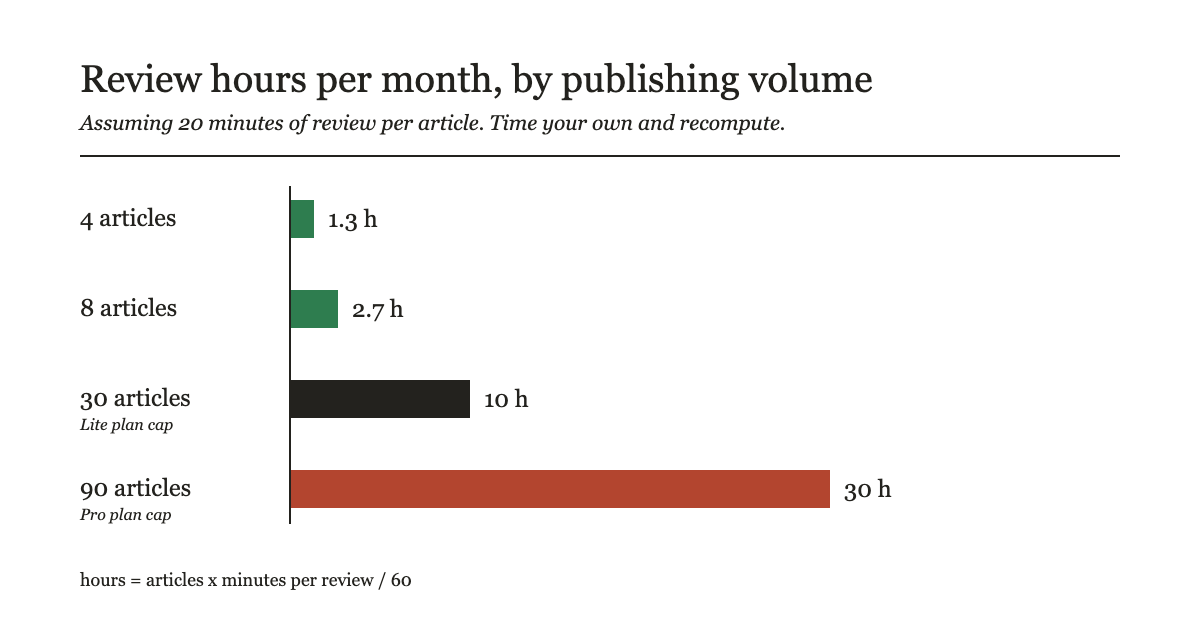
The minutes are assumptions, not measurements. We have not published timing data and will not invent any. Time your first five reviews and put your own number in the formula.
Our Lite plan allows 30 articles a month and Pro allows 90 (pricing). Those are ceilings, not targets. If the review hours for your plan's ceiling are more than you have, publish fewer articles. Cutting the review instead is how a blog ends up with a hundred posts nobody at the company has read.
Where does the gate go in the publishing pipeline?
The gate goes wherever an article can wait in a non-public state until a person moves it forward. Most publishing platforms already have that state. The WordPress REST API, for example, accepts draft and pending as post statuses alongside publish (WordPress developer reference). A tool that creates posts as drafts leaves the approval inside the CMS your team already uses. A tool that creates them as published has made the decision for you.
Ask any automation vendor, including us, one question: after the AI writes an article, what is the next thing that happens to it, and who triggers that? If the answer is a schedule, there is no gate.
How do you review with Blogtastic as it works today?
With a connected integration you cannot hold a post for approval before it goes live. We do not have a setting that sends posts to your CMS as drafts. That is a gap in the product, and we would sooner state it here than have you find it after the fact. What exists today:
Review before publishing, without an integration. If no platform is connected, generated articles stay as drafts in the dashboard. You can edit the text, rewrite a selected passage with AI, and press Publish when it passes your checks. The catch is that the article then has to reach your site by connecting the integration at that point or by moving it by hand, and once an integration is connected, later articles publish on their own. This works for a low volume and gets clumsy fast.
Review the inputs before anything is written. The scheduler shows upcoming articles by topic, and with auto-schedule switched on (it is off by default) it fills the calendar five days ahead. You can delete a scheduled article before it is generated, and you can set site-wide instructions and exclusions plus instructions per topic. This catches off-topic and duplicate articles. It does not check a single fact.
Review on the day of publishing, with an integration. Read each article the day it goes live and fix any errors directly in your CMS. This is correction, not a gate. We think it is acceptable only for topics where a short-lived error does little harm, and not for anything involving health, money, legal questions, or your own prices.
You can see the scheduling and editing tools on the features page.
What does review not fix?
Review removes errors. It cannot add substance that was never in the draft. If the reviewer keeps sending articles back for having nothing original in them, the fix is upstream, in what you feed the tool: your own data and the questions your customers actually ask. We covered that test in Does Google penalize AI-generated content?
Review also fails quietly when it turns into a rubber stamp. Keep a count of how often the reviewer changes or rejects an article. If that count stays at zero for months, either the drafts are flawless or nobody is reading them, and the second explanation is far more likely.
This article was drafted with AI. Its claims were checked on 2026-10-01 against the linked documentation and against our own code, and it stayed unpublished until a person read and approved it. That is the pre-publish kind of review, and it is the kind we recommend.