AI Content and E-E-A-T: What a Draft Can Supply and What Only You Can
Google applies the same E-E-A-T standard to AI-assisted content as to anything else. A model can help with accuracy and structure, but it has no experience of its own and it cannot be your author. Here is how to fill those gaps honestly, including the byline gaps in our own product.
Blogtastic Team · October 23, 2026
To meet E-E-A-T with AI-assisted content, treat the model as a researcher and drafter, then add the parts it cannot produce, starting with first-hand experience and a real author. Then fact-check the result. Google holds AI-assisted content to the same standard as everything else. Its 2023 guidance says creators should aim for "original, high-quality, people-first content demonstrating qualities E-E-A-T" however that content is produced.
A model can help with half of that standard. It can organize what is known and make sourcing clear. It has never used your product or run your test, and it cannot be the person your byline names. Those parts have to come from you. We will show where our own product falls short on the author part too.
Key takeaways
- Google says "E-E-A-T itself isn't a specific ranking factor," and that "trust is most important" of the four aspects. Its systems look for a mix of signals that indicate content with those qualities.
- Experience is the part AI cannot supply. A model can only pass on experience you give it, and left alone it may write first-person claims nobody can back up. We cut one from our own draft in September.
- Google's helpful content page (last updated 2026-10-05) says its quality raters are trained to treat "using generative AI to produce large amounts of text without manual oversight or curation" as little to no effort. Raters do not set rankings, but it shows what Google is checking its systems against.
- Fabricated authors are out. Google calls made-up author names and false credentials "a form of deception." Byline a real person, or an organization that is honest about being one.
- Check what byline your automation tool writes. Ours puts "Blogtastic" on every Shopify post, and this blog's own byline is still a team placeholder with no author page.
Does E-E-A-T apply to AI-generated content?
Yes, in the same way it applies to anything else. Google's February 2023 post on AI-generated content, written by Danny Sullivan and Chris Nelson for the Search Quality team, says Google's ranking systems aim to reward "original, high-quality content that demonstrates qualities of what we call E-E-A-T." Its FAQ adds that AI content which "satisfies aspects of E-E-A-T" might do well in Search, and if it does not, it might not.
What E-E-A-T is, according to Google's page on creating helpful content: experience, expertise, authoritativeness, and trustworthiness. Google's systems "identify a mix of factors" that indicate content with these qualities. The page is careful on two points that SEO advice often skips. First, "E-E-A-T itself isn't a specific ranking factor." Second, content "doesn't necessarily have to demonstrate all of them," and trust matters most. The bar is higher on topics where bad information could seriously harm people, which Google calls "Your Money or Your Life" topics. For those, its systems "give even more weight" to strong E-E-A-T.
So there is no E-E-A-T score to optimize and no box to tick. There is a set of qualities a reader can see or not see on the page. The question for an automated workflow is which of those qualities the automation can produce.
Which parts of E-E-A-T can an AI draft supply?
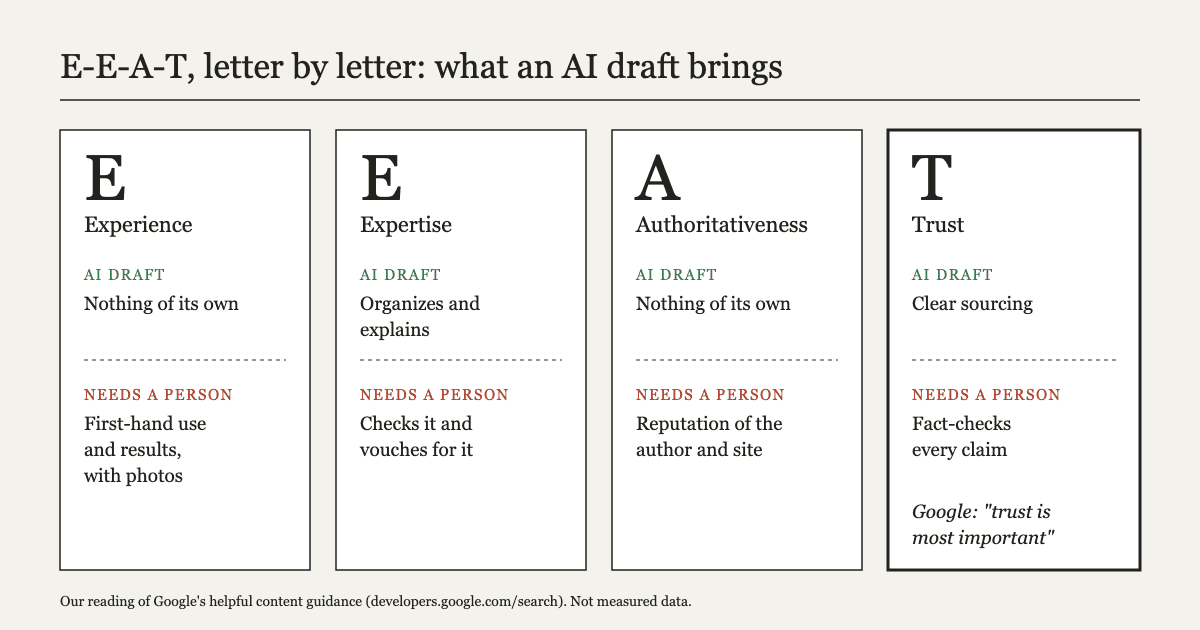
It can help with expertise and trust, and it cannot supply experience or authority. Taking the letters one at a time:
Experience is first-hand: having used the product or done the job yourself. Google added it to its rater guidelines in December 2022, in a Search Central post by Elizabeth Tucker that asks whether content was produced "with actual use of a product, having actually visited a place or communicating what a person experienced." A model has done none of this. It can only describe experience you hand it.
Expertise is knowing the subject. A model can explain a topic clearly and organize the material well, and that is useful. It cannot vouch for itself. Google's own self-assessment question asks whether content is "written or reviewed by an expert or enthusiast who demonstrably knows the topic well." The "reviewed by" part is where automated content earns this letter.
Authoritativeness is reputation: whether people who research your site or author would see them as a recognized source. It belongs to the author and the site, built over time and mostly off the page. No draft supplies it.
Trust is the one Google calls most important, and it rests largely on accuracy. Google's guidance on generative AI content (last updated 2026-10-01) explains why a model cannot guarantee it: "generative models don't retrieve facts, but predict a likely sequence of words based on their training data." The same page says it is "critical to manually factcheck and review all AI-generated content for accuracy and trustworthiness before publishing." A draft can help by citing sources clearly. The fact-check itself is a person's job.
Why do AI drafts sometimes claim experience they do not have?
Because first-person experience is a likely sequence of words in the kind of article being written. Product reviews and how-to posts on the web are full of "we tested" and "in our experience", so a model predicting likely text may produce those phrases whether or not anyone tested anything.
This happened on this blog. The draft of our September article on programmatic SEO and spam contained the phrase "from our own experience building content pipelines." Nothing in the article backed it up, so it was cut during the fact-check. It would have read as an experience signal, and it would have been invented.
The working rule we use: every sentence with "we" or "I" in it needs a fact behind it that a reviewer can point to. A test log, a screenshot, an order history, a named customer conversation. If the reviewer cannot point to one, the sentence goes. This check is quick, and it catches a damaging kind of AI error for E-E-A-T, the kind that looks like a strength.
How do you add real experience to an automated post?
Give the model inputs that only you have, and keep them visible in the published article. Google's helpful content page gives product reviews as the example: readers trust them more when they can see "the number of products that were tested, what the test results were, and how the tests were conducted, all accompanied by evidence of the work involved, such as photographs."
For a store or SaaS blog, inputs like these work:
- Your own numbers, such as return reasons, support ticket counts, which plan customers pick, or how long setup took.
- Photos or screenshots you took, not stock images.
- A short note from the person who used the product or did the job: what went wrong, what surprised them.
- Real customer questions, in their wording.
In Blogtastic, this goes into the site-wide Instructions field in settings and the optional Instructions field on each topic. The model uses what you put there. It does not invent experience for you, and if you leave those fields empty, the article will have no first-hand material in it. That is the honest limit of any drafting tool, ours included.
Who should the byline be on AI-assisted content?
A real person who reviewed the article and stands behind it, or your organization if you name it honestly. Google's FAQ answers "Should I add author bylines to all my content?" with: "You should consider having accurate author bylines when readers would reasonably expect it, such as to any content where someone might think, 'Who wrote this?'"
The helpful content page lists the questions behind that, under "Who": "Is it self-evident to your visitors who authored your content?", "Do pages carry a byline, where one might be expected?", and "Do bylines lead to further information about the author or authors involved, giving background about them and the areas they write about?"
Two things not to do, both from Google's documentation:
- Do not invent an author. "Fabricating creator profiles (such as by using AI-generated headshots, made-up names, or false credentials to make content appear as if it was written by human experts) is a form of deception." Google says any deception "makes a page untrustworthy to both users and our automated quality systems."
- Do not byline the AI. Google's FAQ says giving AI an author byline "is probably not the best way" to make clear to readers when AI was part of the process. A disclosure in the article does that job better.
Our own blog does not fully pass this yet. Every post here, including this one, is bylined "Blogtastic Team", and that byline does not lead to an author page. That is accurate, since no fake person is involved. But it does not answer the third "Who" question, and we would rather say so than leave you to notice it.
What byline does an automation tool put on your posts?
Whatever its integration code sends, and that is easy never to check. We checked ours on 2026-10-23, in the current code of each integration:
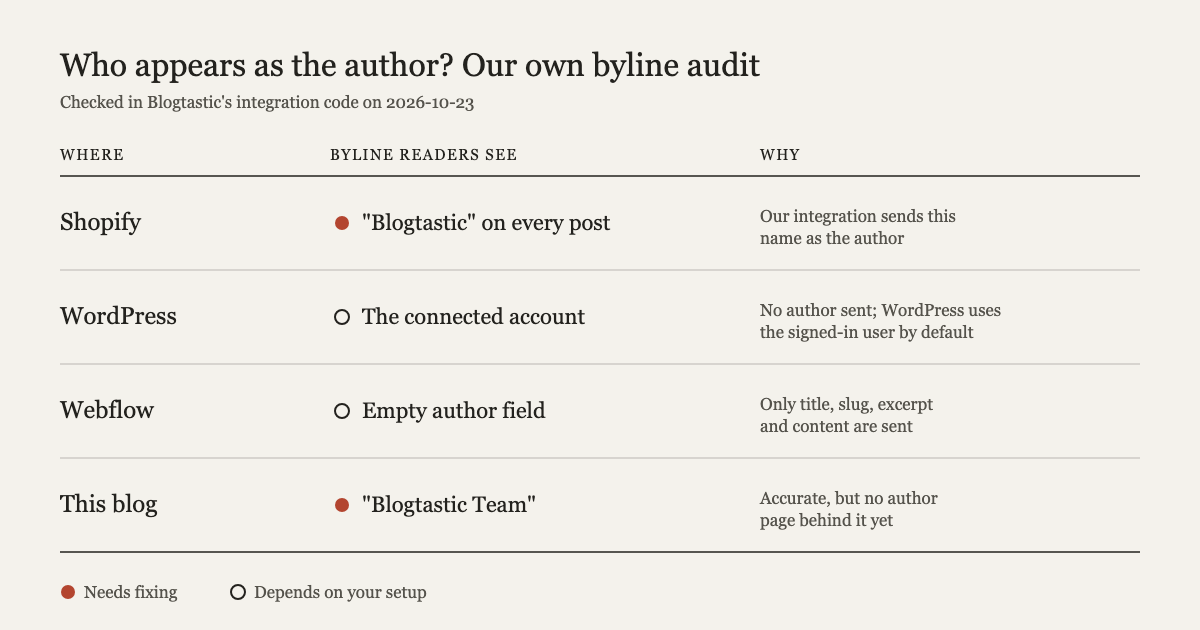
Shopify. Our integration sends the author name "Blogtastic" with every article. Shopify's Article API treats this field as "The name of the author of the article," so your store's blog shows our product name as the writer. Google's FAQ advises against bylining AI, and a tool's brand name in the author field has the same problem: it tells readers nothing about who checked the post. Until that changes, open each post in your Shopify admin and pick a real author from the author dropdown. Shopify's help center notes that blog post authors must be store staff members.
WordPress. Our integration sends no author. WordPress then falls back to its default, which its developer documentation gives as "the current user ID", here the account the integration signs in with. If you connect with an account named "admin", your posts say admin wrote them. Connect with the account of the person who reviews the posts.
Webflow. Our integration fills four fields: title, slug, excerpt, and content. If your blog collection has an author field, it stays empty until you fill it in Webflow.
The setup steps for each platform are on our Shopify blog automation and WordPress blog automation pages. Whatever tool you use, publish one test post and look at the byline before you let it run.
Does Google treat automated content as low effort?
Its rater guidelines do when there is no human oversight, and Google is explicit that raters do not set rankings. The helpful content page (last updated 2026-10-05) describes how raters judge effort: "automatically generating pages from feeds or using generative AI to produce large amounts of text without manual oversight or curation represents little to no effort." It adds: "Attribution or giving credit to other sources doesn't replace the need for original effort."
Read that with the caveat next to it on the same page: "Search raters have no control over how pages rank. Rater data is not used directly in our ranking algorithms." Raters check whether Google's systems seem to be working. So this is not a penalty rule. It is a description of the kind of result Google wants its ranking systems to avoid rewarding, which is a fair hint about what those systems are built to reward.
The phrase that matters for automated blogging is "without manual oversight or curation." We have said this in earlier articles and will keep saying it: in Blogtastic, articles wait in the editor for you to review and publish, unless a WordPress, Shopify, or Webflow integration is connected. With an integration connected, generated articles currently go live with no review step. If that is your setup, review each post in your CMS as soon as it appears, or leave the integration off and publish from the editor. Our article on adding human review to an AI content workflow covers how many hours that review takes at each volume, and the pricing page shows the monthly article caps that set that volume. The features page lists what the editor lets you change before publishing.
A detector score does not help with any of this, for the reasons in our piece on whether AI content detectors matter for SEO. E-E-A-T is shown by what is on the page and who stands behind it.
This article was drafted with AI and checked on 2026-10-23 against the documentation linked above and against our own integration code. The first-person claims in it describe things we did and can show. It stayed unpublished until a person reviewed and approved it.