Programmatic SEO vs Spam: Where Google Actually Draws the Line
Programmatic SEO is not spam by definition. It becomes spam when the pages differ only by the keyword swapped into a template. Here is a test you can run on your own pages in ten minutes, mapped to the Google policies it protects you from.
Blogtastic Team · September 24, 2026
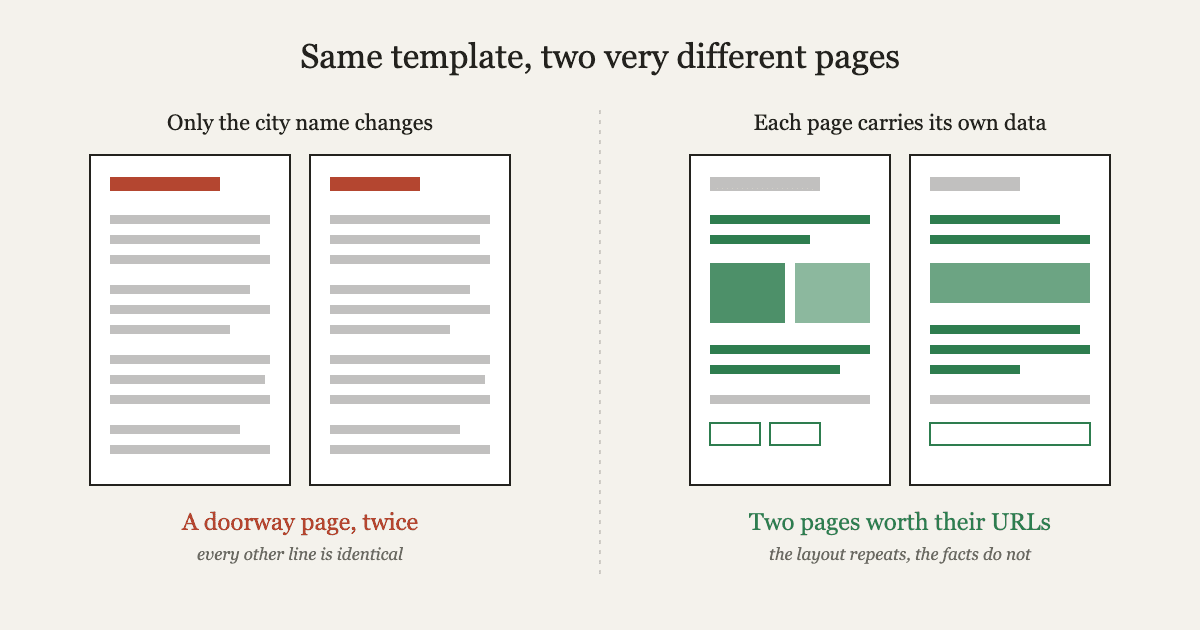
Programmatic SEO is not spam by definition. Google has no policy against generating pages from a template or a database. It has two policies against what most programmatic projects end up producing: many near-identical pages built to catch search queries instead of serving the person who lands on them. The template is fine. Pages that differ only by the keyword you swapped into it are the problem.
Key takeaways
- The spam line is not automation and not volume. It is whether each page carries information that the other pages in the set do not.
- The two policies that catch bad programmatic SEO are doorway abuse and scaled content abuse. Both are defined on Google's spam policies page (last updated 2026-08-28 when we checked it on 2026-09-24).
- Google has said since March 2024 that scaled content abuse applies whether pages come from AI, from people, or from both.
- You can test your own template with two pages and a delete key. The method is below.
What does Google actually prohibit?
Google prohibits pages made at scale mainly to rank, not a production method. The spam policies define scaled content abuse as "when many pages are generated for the primary purpose of manipulating search rankings and not helping users," and add that it is typically unoriginal content that "provides little to no value to users, no matter how it's created."
The second policy is doorway abuse: "when sites or pages are created to rank for specific, similar search queries." Two of Google's listed examples read like a description of a lazy programmatic build:
- "Having multiple domain names or pages targeted at specific regions or cities that funnel users to one page"
- "Creating substantially similar pages that are closer to search results than a clearly defined, browseable hierarchy"
The "no matter how it's created" part matters for anyone who thinks hiring writers is a safe alternative to AI. When Google introduced the scaled content policy in its March 2024 announcement, it said it would act "no matter whether content is produced through automation, human efforts, or some combination of human and automated processes." A team of freelancers rewriting the same page for 400 cities does not get a pass.
So what makes a programmatic page legitimate?
A programmatic page is legitimate when it would still be useful if it were the only page on the site. That usually means it is built on data that is specific to that page: real inventory, real prices, real specs, real reviews, real measurements. The template decides the layout. The database decides the content.
Compare two projects that both publish one page per city:
| Page set A | Page set B | |
|---|---|---|
| What changes per page | The city name, in the title and four sentences | Listings, prices, opening hours, local regulations, photos |
| What stays the same | Every other paragraph | The layout and the navigation |
| Would a visitor from that city learn anything specific? | No | Yes |
| Likely policy risk | Doorway abuse, scaled content abuse | Low, if the data is accurate and current |
Both are "programmatic SEO." Only one of them is a doorway.
How do you test whether your template crosses the line?
Run what we call the swap test. It takes about ten minutes and needs no tools.
- Pick two pages from the same template, ideally ones that target very different variables (a large city and a small one, a cheap product and an expensive one).
- Copy the body text of both into a document.
- Delete every occurrence of the variable: the city name, the product name, the keyword.
- Read what is left. Mark every sentence that is identical or near-identical between the two pages.
- Ask whether the unmarked sentences contain facts a visitor could not get from the other page.
If almost everything is marked, you have one article published many times with a word changed. That is the pattern both policies describe. If the unmarked sentences carry real, page-specific information (numbers, conditions, availability, differences that affect a decision), the page is earning its URL.
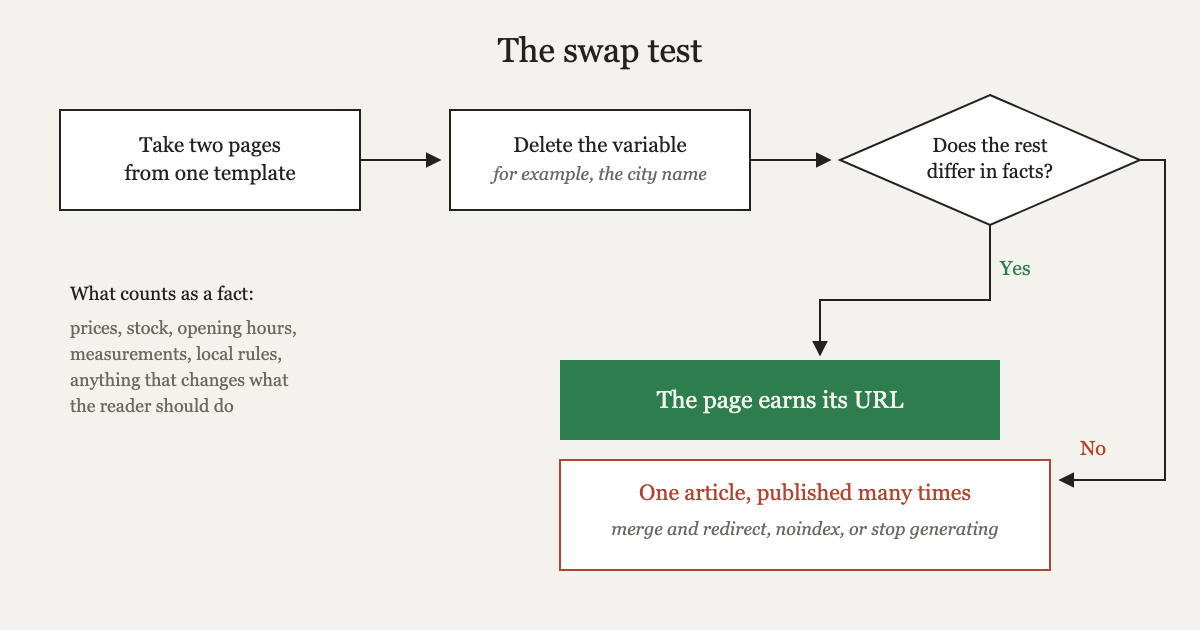
We do not publish a percentage threshold, because Google does not and any number we invented would be false precision. The question is qualitative: would the visitor lose information if you deleted this page and sent them to its sibling?
What are the warning signs before you publish 500 pages?
Google's own guide to creating helpful content lists self-assessment questions, and several of them read like a programmatic SEO audit. Among the warning signs it names:
- "Are you producing lots of content on many different topics in hopes that some of it might perform well in search results?"
- "Are you using extensive automation to produce content on many topics?"
- "Are you mainly summarizing what others have to say without adding much value?"
Four more signs are specific to templates:
The dataset is thinner than the page count. If you have 40 rows of real data and 400 target keywords, 360 pages will be filled with prose, not data. Generate 40.
The variable does not change the answer. "How to clean a leather sofa in Denver" and "in Austin" have the same answer. A city variable only belongs in the URL if something about the city changes what the reader should do.
You could not maintain it. Pages built on prices, stock, or regulations go stale. If nobody owns updating them, they drift from true to wrong, and a wrong page at scale is worse than no page.
The pages exist only in the sitemap. If a visitor cannot reach a page by browsing your site, only by searching, you have built the thing Google's doorway examples describe: pages "closer to search results than a clearly defined, browseable hierarchy." Every generated page should sit in a category or index page a person would actually click through.
What should you do with pages that fail?
Stop generating new ones first, then deal with what is live. Google's spam policies say plainly: "If you're hosting such content on your site, exclude it from Search." In practice there are three options, and the right one depends on whether the pages have value to anyone:
- Merge near-duplicates into one strong page and 301 redirect the rest to it, if the topic deserves a page.
- Noindex pages that are useful to logged-in users or on-site navigation but add nothing in search results.
- Delete pages that serve no one, and redirect any that still receive visits or links.
Before removing anything at scale, check your traffic data in both Google Search Console and Bing Webmaster Tools. Pages that look dead in one search engine are sometimes still sending visitors from the other.
Where does an AI blog tool fit in this?
An AI blog tool can produce doorway pages just as easily as a template engine can. Faster, in fact. The swap test applies to our output too: two AI articles on neighboring keywords that say the same things in different words fail it the same way two templated city pages do.
Blogtastic is built around articles, not page templates: one topic at a time, picked from AI topic suggestions for your site, with paid plans capped at 30 or 90 articles a month (see pricing). A monthly cap also means one idea cannot turn into hundreds of URLs overnight. That said, a limit is not a quality check. If you feed the tool 30 variations of one keyword, you will get 30 variations of one article, and you should not publish them. You can see how topic suggestions work on the features page. For the broader question of how Google treats AI-written content, we covered the policy side in Does Google penalize AI-generated content?
This article was drafted with AI and fact-checked against Google's documentation on 2026-09-24, and a person reviewed it before it was published. Every policy quote above links to its source so you can check it yourself.