Do AI Content Detectors Matter for SEO?
Not as a ranking factor you can measure. Google's documentation describes judging content by usefulness and spam patterns, not by a detector score, and published tests show detectors misread plain human writing. Here is the evidence and what to check instead.
Blogtastic Team · October 16, 2026
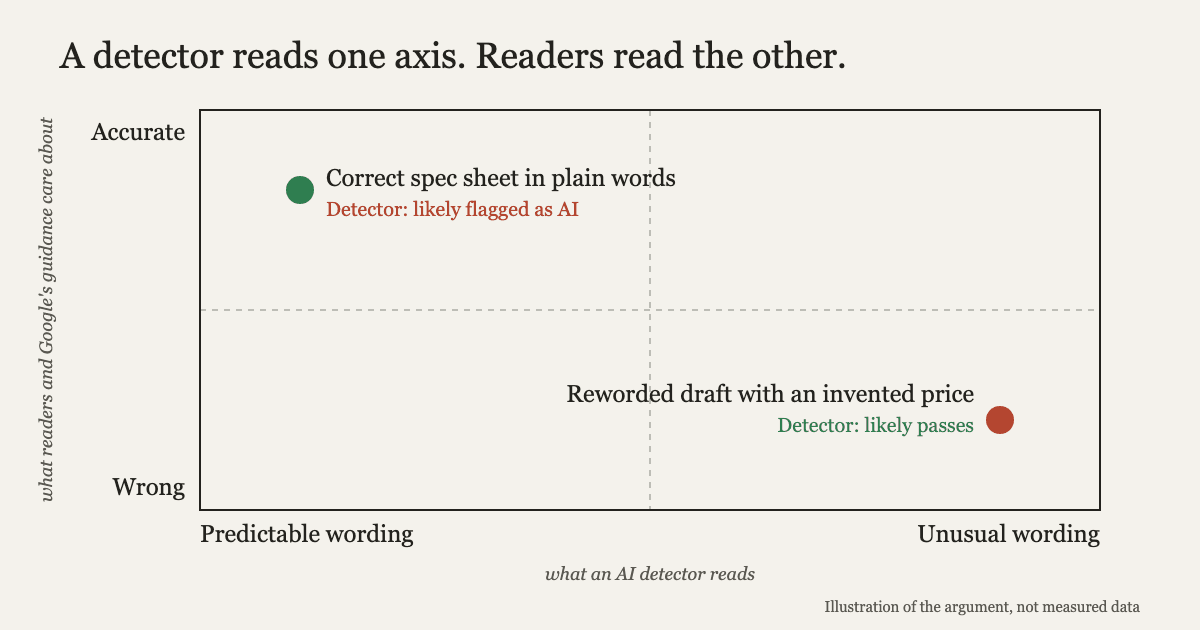
For SEO, an AI detector score is not worth optimizing. Google's Search documentation does not describe ranking pages by whether a detector thinks a machine wrote them. It describes fighting spam "however it is produced" and asks for accurate, useful content. The detectors are also unreliable in a way that hits blogs directly: in published tests they flag plain, simple human writing as AI far more often than more varied writing.
That makes a common workflow backwards. Running a draft through a detector, then through a "humanizer" until the score drops, changes the wording and leaves every factual error where it was. For the record, Blogtastic includes neither a detector nor a humanizer, and we do not claim our drafts pass detectors.
Key takeaways
- Google's own FAQ answers "How can Search determine if AI is being used to spam search results?" by pointing to SpamBrain and pattern analysis of spam "however it is produced". It does not say Search identifies AI text.
- Google's guidance on generative AI (last updated 2026-10-01) says it is "critical to manually factcheck and review all AI-generated content for accuracy and trustworthiness before publishing." It asks for human review. A detector pass is not that.
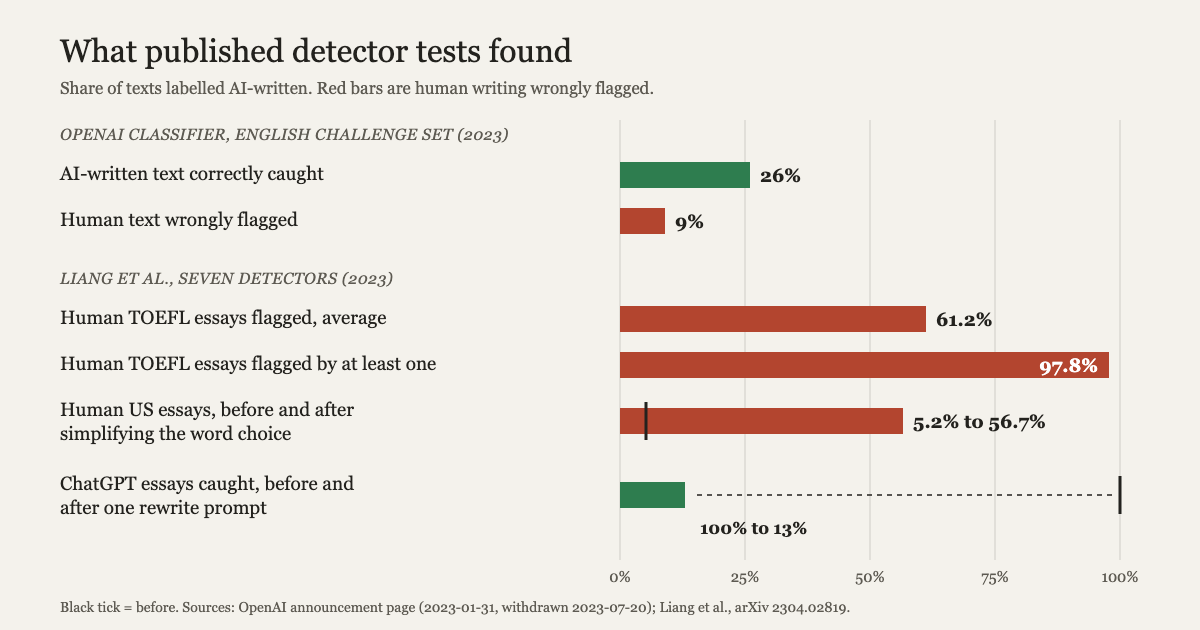
- OpenAI withdrew its own AI text classifier on 2023-07-20 "due to its low rate of accuracy". In OpenAI's tests it caught 26% of AI-written text and labelled human text as AI 9% of the time.
- In a 2023 study of seven detectors, asking ChatGPT to simplify the word choice in human-written essays raised the average false-positive rate from 5.19% to 56.65%. Clear writing is the style these detectors misread.
- Spend review time on facts and substance. A score that one rewrite prompt can move from 100% to 13% does not measure quality.
Does Google use AI detection to rank content?
Google has not said that it does, and what it has said points elsewhere. In its 2023 guidance on AI-generated content, written by Danny Sullivan and Chris Nelson for the Search Quality team, the FAQ asks how Search can tell whether AI is being used to spam results. The answer: "We have a variety of systems, including SpamBrain, that analyze patterns and signals to help us identify spam content, however it is produced." The same FAQ says plainly: "Using AI doesn't give content any special gains. It's just content."
The current spam policy on scaled content abuse (last updated 2026-08-28) is built the same way. It targets "many pages" generated "for the primary purpose of manipulating search rankings and not helping users", and it applies "no matter how it's created."
One limit on what we can claim: Google does not publish every signal its systems use, so "not documented" is not proof that no such signal exists. What the documentation supports is narrower and still useful. The question Google says it asks is whether a page exists to help people or to manipulate rankings. A detector does not answer that question, and a page can fail it with no AI involved at all.
What does an AI detector actually measure?
A detector estimates how likely it is that a language model produced the wording. It does not check whether the content is true. The 2023 study by Liang and colleagues, "GPT detectors are biased against non-native English writers" (later published in the journal Patterns), ties the errors to perplexity, a measure of how predictable each next word is to a language model. The human essays that all seven detectors flagged had significantly lower perplexity than the ones they let through.
So a detector reads one property of the text, how predictable the words are, and nothing else. Whether the price in paragraph three is right never reaches the score. Neither does whether the article says anything the top results do not.
How accurate are AI detectors?
By their makers' own figures, not accurate enough to act on. OpenAI released a classifier in January 2023 and published its numbers on the announcement page: on an English "challenge set" it labelled 26% of AI-written text as likely AI and wrongly labelled human text as AI 9% of the time. OpenAI listed limits alongside those numbers. The classifier was very unreliable below 1,000 characters and performed significantly worse outside English. It sometimes labelled human text as AI with high confidence, and editing AI text could get it past the classifier. It also advised against using the classifier as a primary decision-making tool. On 2023-07-20 OpenAI took it down.
The Liang study tested seven widely used detectors on 91 essays written by people for the TOEFL English exam and 88 essays by US eighth-grade students. The detectors were close to perfect on the eighth-grade essays. On the TOEFL essays the average false-positive rate was 61.22%, and 89 of the 91 (97.80%) were flagged as AI by at least one detector.
These tests are from 2023. Detectors and language models have both changed since, and we have not retested any detector for this article. Newer detector vendors publish their own accuracy claims. A vendor's claim about its own tool is not an independent test.
Why would a detector flag good web writing?
Because good web writing is predictable on purpose. In the same study, the researchers took the eighth-grade essays, which detectors had handled well, and had ChatGPT simplify the word choice. Average false positives across the detectors rose from 5.19% to 56.65%. Nothing about authorship changed, only the vocabulary.
Short sentences and common words make a product page or a how-to easy to read. They also lower perplexity. OpenAI's own limitations list makes the extreme version of this point: very predictable text, such as a list of the first 1,000 prime numbers, cannot be attributed to anyone, because the correct answer is always the same. Spec sheets and step-by-step setup instructions sit near that end of the scale. If you write them well, a detector has less to go on, and a high score tells you nothing about who wrote them.
Should you run AI content through a humanizer?
Not for SEO. A humanizer rewrites wording until the detector score drops, a property Google's documentation never mentions. The Liang study shows how little the score means. Researchers generated 31 college-admission essays with ChatGPT-3.5, which the detectors initially caught every time, then gave ChatGPT one follow-up prompt asking it to rewrite in more literary language. Detection fell from 100% to 13%. The essays were no truer and no more original afterward.
Google's scaled content policy does name "synonymizing" as an obfuscation technique, in its example about scraped content that is transformed to look new. Rewording your own draft is not what that example describes, and we will not stretch it into a penalty claim. The shared lesson is simpler: mechanical rewording adds nothing for the reader. And every automated rewrite is one more pass that can change a number or a meaning, so a humanized draft needs fact-checking again.
Is an AI detector useful for anything?
At most as a reason to ask questions, never as a verdict. If you pay a freelancer for first-hand reporting and a long sample scores high, ask for their notes and sources. Those answer the question. The score does not. OpenAI advised against using its classifier as a primary decision-making tool, and the Liang authors caution against using detectors in evaluative or educational settings.
The one place Google asks for an AI label is not a detector at all. Its generative AI guidance notes that under Google Merchant Center policies, "AI-generated images must contain metadata using the IPTC DigitalSourceType TrainedAlgorithmicMedia metadata." That is a label the publisher adds, which is the opposite of guessing after the fact.
What should you check instead of a detector score?
Check what the detector cannot see. Google's guidance says the manual fact-check and review it asks for also covers metadata, including title elements, meta descriptions, structured data, and image alt text. In practice:
- Every number, price, date, and named product has a source the reviewer opened.
- Every statement about your own business is confirmed by someone who knows it.
- The article contains at least one thing the current top results do not.
- The title and meta description promise only what the body delivers.
- AI use is disclosed where a reader would wonder "How was this created?", the wording Google uses in its helpful content guidance.
Our article on adding human review to an AI content workflow covers who should do this and how many hours it takes at each publishing volume. For where the real penalty risk sits, see what Google's policies say about AI content.
If you use Blogtastic, review happens in the article editor before you press Publish. One caveat we keep repeating because it matters: with a WordPress, Shopify, or Webflow integration connected, generated articles currently go live without that step. The features page lists what the editor can do, and the pricing page shows the monthly article caps, which are also the ceiling on how much review you are signing up for.
This article was drafted with AI and checked on 2026-10-16 against the primary sources linked above and against our own code. We did not run it through an AI detector, for the reasons above. It stayed unpublished until a person reviewed and approved it.